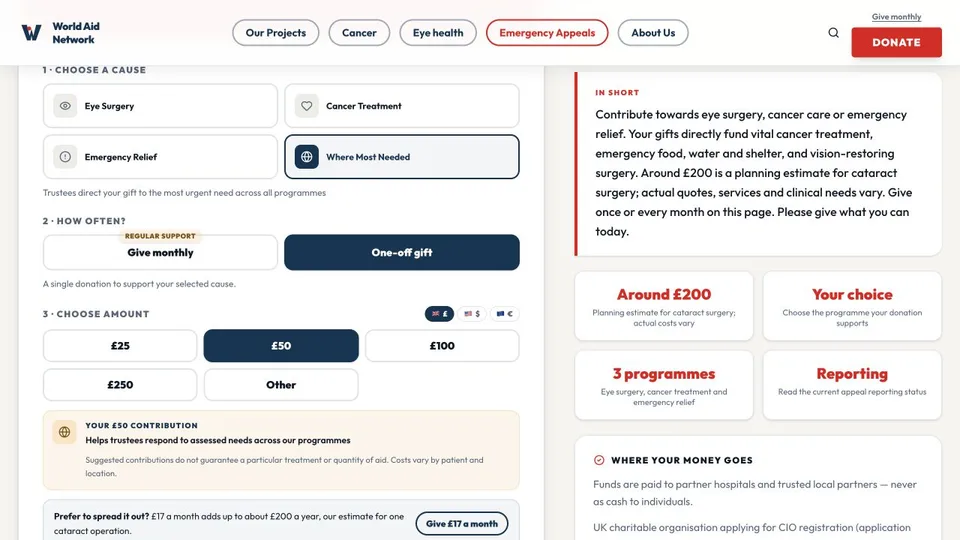
Donation-page viewport captured on 6 October 2026. This records the visible interface; no payment was submitted. Inspect the live page →
Website delivery project. World Aid Network’s live footer credits Elite Digital Agency as the website builder. The organisation’s own statements are identified as such below.
What was the challenge?
A first-time donor needs to understand both the cause and the organisation before sharing payment details. The website has to explain different giving choices and make registration, Gift Aid and reporting status easy to check. Those trust questions matter as much as a prominent donation button.
Elite Digital built World Aid Network’s public website around three donor tasks: understanding an appeal, choosing how to give and checking the information behind it. This case study documents the published donation interface and reporting pages, with sources checked on 6 October 2026.
The work and its scope
Give visitors a cause-led route into the site, then bring them to a common donation form so each appeal does not need a different payment journey.
Group the donation form around decisions donors recognise: cause, one-off or monthly support, amount and contact details.
Place a link to registration information near the giving journey, with wording that distinguishes an application reference from a registered charity number.
Give reporting its own destination and distinguish donations received, payments to partners and delivery reported. Planning estimates are labelled separately from completed activity.
Keep appeal explanations and frequently asked questions readable as page content. These help visitors understand the offer; their presence does not prove a search ranking or an AI citation.
Outside this engagement:
Charity registration or HMRC recognition
Donor CRM or charity back-office implementation
Independent financial or programme-outcome audit
A measured conversion experiment for this case study
Which reader tasks shaped the design?
I know which cause I want to support.
Offer cause choices within a common giving form.
A donor can express a preference while using a consistent sequence for the remaining payment decisions. The alternative ‘where most needed’ is available when they do not want to choose a programme.
I want to understand my commitment before giving.
Show frequency and amount as separate choices before donor details.
This makes a recurring gift a deliberate decision and gives the reader a clear place to review the amount. Whether it improves completion requires payment and analytics evidence.
I want to know what has actually been delivered.
Give reporting status a dedicated page, separate from appeal estimates.
Readers can distinguish what a programme intends to fund from financial receipts and verified delivery. That is a content-design decision, not an audit of the programme itself.
What can you verify on the live site?
We inspected the public donation, registration-status and impact pages on 6 October 2026. The observations concern visible content and interface choices. We did not submit donor details or make a payment.
Giving interface
The donation page offers four cause choices and one-off or monthly giving, followed by an amount and donor details. It identifies Stripe as the payment provider.
Evidence limit: The public interface was inspected. Successful payment processing, recurring billing and receipt delivery were not tested for this evidence update.
The dedicated status page says the CIO application is pending, explains that the application reference is not a charity number and states that Gift Aid is not currently available.
Evidence limit: This records the organisation’s published disclosure; it does not independently confirm legal or regulatory status.
The impact page separates money received, partner payments and delivery reports. It explicitly says verified programme totals and delivery reports are not yet published.
Evidence limit: Unavailable totals are not zero activity. No fundraising total, beneficiary count or clinical outcome is claimed in this case study.
Source: Donation form; observed 6 October 2026. Payment completion was not tested. View source
4
Cause choices in the form
Source: Eye surgery, cancer treatment, emergency relief and where most needed; donation page, 6 October 2026. View source
Application pending
Registration wording
Source: Organisation’s own status page, 6 October 2026; this is not independent verification of registration. View source
Status disclosed
Public impact reporting
Source: Impact page says verified programme totals and delivery reports are not yet published; checked 6 October 2026. View source
What would establish a measured result?
No dated pre-launch interface capture or comparable donation analytics is included in the case-study evidence. We can demonstrate the published design, but cannot attribute a change in conversion, donations or traffic to it.
Evidence needed for a future results update
Donation completion
A defined count of donation starts and confirmed successful payments, with test transactions removed and the same reporting window for both.
Fundraising receipts
Settled payments reconciled with refunds and chargebacks, currency treatment and the reporting dates stated. Receipts must remain separate from programme delivery.
Design impact
Comparable periods or an experiment, with campaign spending, seasonality, traffic source and other site changes documented before attributing any uplift.
What did we deliver?
Public website design and build, credited in the live site’s footer
Appeal and programme pages with routes to the donation form
One-off and monthly giving interface with a Stripe checkout handoff
Registration-status and donor-information pages
Programme reporting layout with visible publication status
Page headings, metadata and internal navigation for discoverable content
World Aid Network (worldaidnetwork.org/) was designed and built by Elite Digital Agency, the trading name of Elite Digital AI Solutions Ltd (Companies House 17250017). Services included Web design & development, Donation journey design, Content architecture.
What was the main challenge for World Aid Network?
A first-time donor needs to understand both the cause and the organisation before sharing payment details. The website has to explain different giving choices and make registration, Gift Aid and reporting status easy to check. Those trust questions matter as much as a prominent donation button.
What did Elite Digital not do on this project?
Out of scope: Charity registration or HMRC recognition; Donor CRM or charity back-office implementation; Independent financial or programme-outcome audit; A measured conversion experiment for this case study.
What has been verified for this case study?
We checked the linked public pages on 6 October 2026. World Aid Network’s site connects cause pages, a donation form and public reporting information. The published interface demonstrates the delivery scope. This case study does not establish donation growth, payment completion rates or programme outcomes: those require separate records and a defined comparison period.
Planning a similar website?
Tell us about your project. We'll give you an honest assessment of scope, timeline and fit — including if we are the wrong option.